
Two-Way Radio Comm vs. Mobile Phones in Business

The comparison between two-way radios and mobile phones in the business arena where safety is essential, particularly as of 2026, reveals significant advancements and shifts in communication technology, especially within construction and logistics sectors:

  1. Unified Connectivity:

    • Traditional two-way radios often suffered from “dead zones” or connectivity gaps.
    • Modern solutions integrate satellite, 5G, and AI-driven monitoring to ensure seamless communication anywhere, eliminating black holes.
    • Hybrid satellite-to-cellular systems and private 5G networks provide continuous connectivity in remote and large-scale sites.
  2. Advanced Asset and Safety Tracking:

    • Two-way radios mainly supported voice communication; now IoT and AI enhance asset tracking beyond location to cargo condition.
    • Wearables and sensors connected via advanced networks monitor worker safety and trigger preventive actions automatically.
  3. Modernised Site Communication:

    • Site offices have evolved from poorly connected cabins to digital hubs using cloud PBX and VoIP.
    • Smartphones with office extension capabilities and AI-powered video triage improve operational efficiency and remote inspection.
  4. Enhanced Hardware and Security:

    • Ruggedised devices running Mission-Critical Push-to-Talk over LTE/5G replace legacy radios, offering encrypted, instant communication worldwide.
    • Security compliance such as end-to-end encryption is critical to protect sensitive construction site data and 3D models.

In essence, while traditional two-way radios provided basic voice communication, the integration of mobile technologies, satellite, 5G, AI, and IoT in 2026 delivers a comprehensive, secure, and intelligent communication ecosystem that significantly improves safety, connectivity, and operational oversight in industries where these factors are vital.
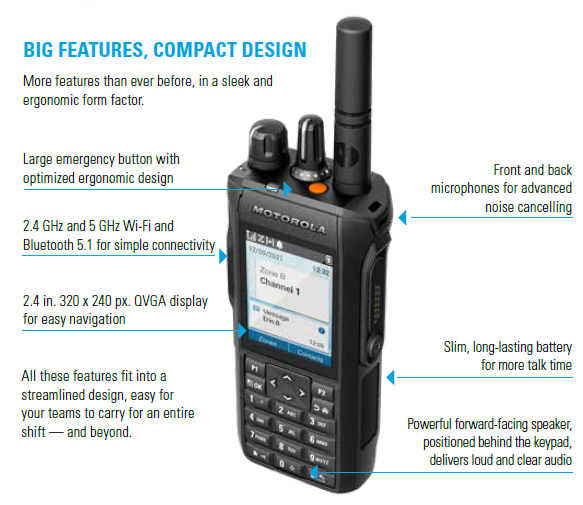

NEW – Mototrbo™ R7 Two-Way Radio

Due to global semi-conductor supply issues, there have been significant supply problems over the last few months with Two-Way Radio products and accessories.

However, there is now GOOD NEWS; Motorola have just announced a new radio model, the Mototrbo R7, which is compatible with DP4000(e) series radios and chargers.

The R7 series is available in both non-display and display versions – see data sheet.

Key Features include:

mototrbo-R7 key features


We will advise on availability as soon as we receive an update, but these radios are expected very soon.

If you wish to discuss new orders, or replacing existing DP4400e orders with R7 radios, please contact the radio team for costs at radios@businesscomms.co.uk or call 0203 4188 039


Is it Time to Replace your Motorola Two-Way Radio Battery?

Signs that your radio battery needs to be replaced include the Motorola battery requires you to recharge it continually shorter intervals and/or the radio is constantly beeping when turned on or transmitting.

However, we recommend the best way to ascertain if your Motorola Two-Way Batteries need to be replaced, is for you to check them against the reference key on your Motorola Multi-Unit Charger:Motorola Two-Way Radio

  • If the charger LED is AMBER, the battery is reforming and should be left to complete this
  • If the battery flashes RED/GREEN, it is nearing the end of its useful life
  • Flashing RED means the battery will not charge and before you replace it, check the connection in the charger just in case
  • Solid RED means the battery is charging
  • Solid GREEN means the battery is charged and ready for use

For more information, read our article Is Your Two-Way Radio Battery Treated Right?

Otherwise, contact us if you have any further questions.

Relocation of the Staisafe Radio System in Staines

Business Comms engineers have completed the first phase of the relocation of the Staisafe radio system in Staines-upon-Thames.

This involved the recovery of two base station repeaters and an antenna array from a now defunct department store and installing the equipment at the top of a nearby multistorey car park.

This is the first phase of the project.

The second phase will be completed with the issue of a revised licence from Ofcom and the purchase of a two channel combiner which will enable the two repeaters to be connected to a single replacement antenna array.

Contact us for your two-way radio communication requirements on   0203 4188 039 / enquiry@businesscomms.co.uk